

Level 4 Château de Versailles: French Upper Intermediate Program for Kids Ages 9+
Our students master l'imparfait (imperfect tense), distinguish between past tenses, use complex pronouns, and begin the subjunctive mood across 20 sophisticated themes.
Welcome to Level 4 Château de Versailles, our French upper intermediate program designed for children ages 9 and up who have completed Level 3 or have strong intermediate French skills. This sophisticated level perfects past tense distinction and introduces the subjunctive mood.
Welcome to Level 4 Château de Versailles
- Complete in 1 year (2 classes/week)
- Master 4 major tenses + subjunctive mood introduction
- Advanced grammar: Relative pronouns, modal verbs, complex structures
- Master 800+ new words across 20 sophisticated themes
- Perfect past tense distinction (passé composé vs imparfait)
- Write structured multi-paragraph texts with logical connectors
- Hold 15+ minute conversations
Trusted by 500+ families | Perfect 5/5 rating

What your child willlearn
With native French teachers and our masterfully designed 20-session curriculum, your child will master l’imparfait (imperfect tense), distinguish between past tenses, use complex pronouns (COI, relative, en/y), master the subjunctive mood, and express themselves with the nuance and sophistication of an advanced French speaker. From giving opinions to expressing wishes and emotions, they’ll communicate naturally in any French context.

Objectives



Skills








Is right for yourchild?


Your child’s journey through Level 4 Château de Versailles
Perfect Past Tense Mastery
• Self-presentation (background, passions, qualities, flaws)
• Sports & accessories
• Professions & professional tools
• All sentence types (declarative, interrogative, exclamatory, imperative)
• Modal verb structures and negation (pouvoir, devoir, vouloir, falloir, savoir)
• Complement pronouns COD (le/la/les - revision)
• Complement pronouns COI (lui/leur, me/te/nous/vous)
• Interrogative sentence structures (revision of all question forms)
• Text structure with paragraphs
• Logical connectors (donc, mais, car, parce que, cependant)
• Indicative present (complete revision)
• Imperative (revision)
• Modal verbs in present (pouvoir, devoir, vouloir, falloir, savoir)
• Passé composé (complete revision)
• Past participle agreement with "être"
• Past participle agreement with "avoir"
• Synthesis of all past participle agreement rules
• Cédille and accents
• [k] sound: C, K, QU, Q, CH
• Intonation by sentence type
• [gn] sound
• Create personal "memory box" portrait
• Discuss past background and experiences
• Structure paragraphs logically
• Use connectors to organize ideas
Your child masters all past participle agreements, uses modal verbs in all contexts, employs complement pronouns (COD/COI) naturally, and writes structured multi-paragraph texts!
Past habits • Comparisons and descriptions
• Past habits
• Comparisons and descriptions
• Comparison structures (comparatif/superlatif revision + "comme")
• Emphasis with "c'est...que" and "ce qui/que..."
• Coordinating conjunctions (mais, ou, et, donc, or, ni, car)
• Noun plurals (including special rules for -s, -x, -z endings)
• Determiners and nouns (complete revision)
• Futur proche and futur simple (revision and usage distinction)
• L'IMPARFAIT - formation and usage
• Avoir and être in imparfait
• CRITICAL: Distinguishing imparfait vs passé composé (ongoing vs completed actions, habits vs specific events)
• Consonant clusters (dr, tr, cr, gr, vr, fr)
• [ɛ]/[e] distinction: "je regardais" (imparfait) vs "j'ai regardé" (passé composé)
• [ien] sound masculine vs feminine
• Liaison: determiner + noun
• Discuss past habits using imparfait
• Distinguish between background (imparfait) and actions (passé composé) in narratives
Your child uses imparfait and passé composé distinctly and naturally, knows when to use each tense, and narrates past stories with perfect tense choice!
Advanced Pronouns & Conditional
• Cardinal points
• Expressing location
• Nationalities
• Giving opinions
• Enriching nouns (adjectives and noun complements)
• Nationality adjectives (agreement and feminine forms)
• ALL pronouns revision: personal, demonstrative, possessive
• Relative pronouns (qui/que/où/dont)
• "Noun + relative pronoun + verb" structures in all tenses
• Indefinite determiners/pronouns (aucun/aucune/plusieurs)
• "Tout" in all its uses (adjective/pronoun/adverb/noun)
• Interrogative pronouns (lequel/laquelle/lesquels/lesquelles)
• Logical articulators (parce que, donc, mais, cependant, pourtant)
• Manner/immediate cause with "en + participe présent"
• Aller de/venir de/aller à in present, past, and future
• CONDITIONAL PRESENT with modal verbs (je voudrais, je pourrais, je devrais)
• Future vs conditional distinction
• Liaison: adjective + noun
• Liaison: pronoun + verb
• Liaisons in fixed expressions
• Other liaison types • Forbidden liaisons
• "Plus" pronunciation (context-dependent)
• H aspiré vs H muet distinction
• Give structured opinions
• Express location and direction
• Discuss nationalities and cultural differences
Your child uses all relative pronouns naturally, employs conditional for politeness, masters all liaison rules, and gives sophisticated opinions with logical arguments!
Subjunctive & Advanced Expression
• Giving advice
• Expressing opinions, emotions, wishes, desires
• Interrogative/relative pronoun "lequel" (avec lequel, dans lequel)
• Adverb power and placement
• Expressing instantaneity (dès que, aussitôt que, être en train de)
• Pronouns EN and Y
• Advice structures (impératif, devoir + infinitif, si + présent/futur, si + présent/impératif)
• Complete REVISION of all tenses: indicative present, passé composé, futur proche, futur simple, imperative, imparfait, conditional
• SUBJUNCTIVE MOOD introduction!
• Subjunctive present formation
• "Je veux que/j'aimerais que + subjunctive" (will/obligation/wish)
• "Je pense que/je suis content que + subjunctive" (opinion/feelings)
• Sound review: an, on, in, un (distinction)
• Feminine words in -elle, -ette, -esse
• Language registers (formal, informal, familiar)
• Oral reductions (j'suis, j'vais, y'a - understanding and using appropriately)
• Give advice in multiple ways
• Express wishes and desires
• Share opinions and emotions
• Write sophisticated arguments
Your child masters the subjunctive mood introduction, uses pronouns en/y naturally, expresses wishes and emotions sophisticatedly, understands all language registers, and holds 20-30 minute conversations on any topic! Ready for Level 5!



Whatparents sayabout Level 4




Why Level 4works








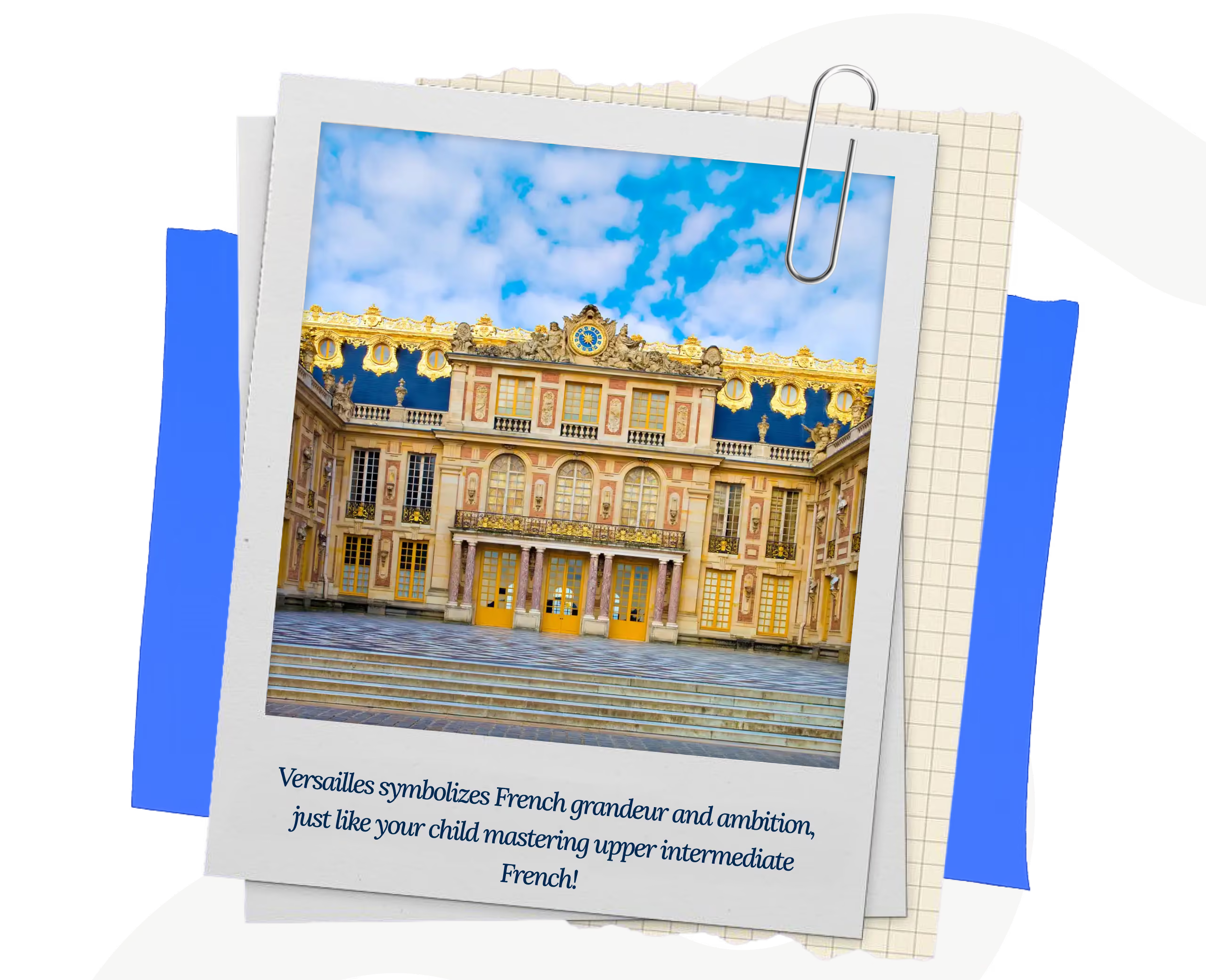
A Bit of French Culture:The Château de Versailles!

Did you know?
The Château de Versailles is one of the most magnificent palaces in the world! This UNESCO World Heritage site was the principal royal residence of France from 1682 until the French Revolution.
Built by Louis XIV (« Le Roi Soleil » – The Sun King)
Features 2,300 rooms, 1,944 windows, and 67 staircases
The famous Hall of Mirrors has 357 mirrors!
The gardens cover 800 hectares with 50 fountains
Required 36,000 workers and 50 years to build
Now a museum visited by 10 million people yearly

FAQsabout onlineFrench classes for kids
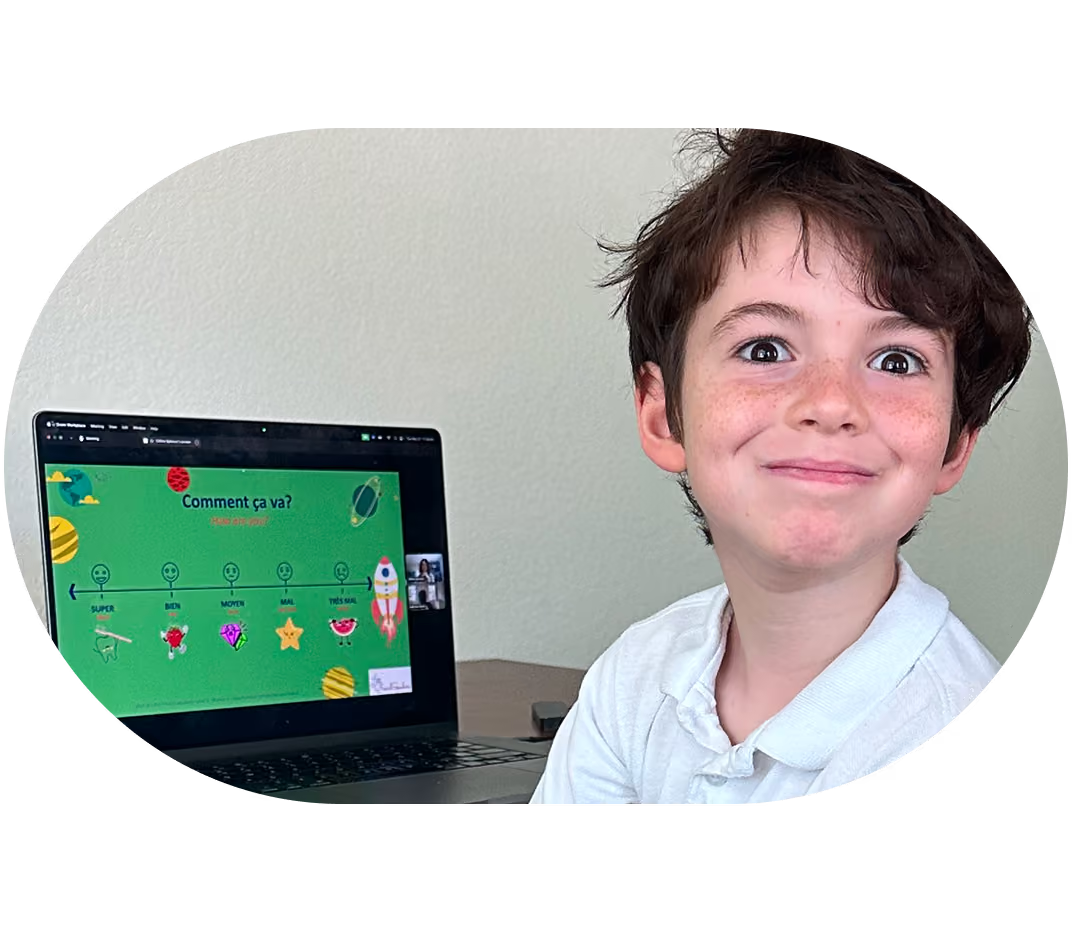
Not at all. All levels are welcome, including complete beginners who have never heard a word of French. Our native teachers use games, visuals, and storytelling to make everything clear and fun from the very first lesson, no prior knowledge needed, just a smile and a screen.

Your child gets a free 25-minute 1-on-1 lesson with a native French teacher. No credit card required, no automatic billing, and absolutely no commitment. You simply decide afterward whether you’d like to continue most families book their first week the same day.
Just a computer or tablet with a camera and a stable internet connection. We use Zoom, you’ll receive a link before every session. No special software, no materials to buy, and no complicated setup. If your child can join a video call, they’re ready to go.
Apps and group classes give every child the same experience. We don’t. Every lesson at Little French Speakers is 100% personalized, built around your child’s level, pace, interests, and goals. They work 1-on-1 with a real native teacher who adapts in real time. No algorithm, no waiting, no getting lost in a group. Just your child and a teacher who’s fully focused on them.
After the free trial, you will receive an email with your child’s level placement and the recommended class duration based on their attention span.
Yes, it is absolutely possible to organize classes for siblings or friends, as long as the children are of a similar age and have a comparable level of French.

Join our amazing French class!
- Personalized 1-on-1 lessons
- 25 minute or 50 minute classes
- All teachers are native French speakers
- 100% online interactive program
Online French Classes for Kids: From First Words toReal Conversations.

Level 0.1Early Years
“My first magical French words!”


Ready for Level 1
Tour Eiffel →

Level 1Beginner
“Bonjour! My first French words!”
Ready for Level 2
Arc de Triomphe →
Level 2Upper Beginner
“I can talk about my daily life!”
Ready for Level 3
Cathédrale Notre-Dame →

Level 3Intermediate
“French conversations feel natural now!”

Ready for Level 4
Château de Versailles →
Level 4Upper Intermediate
“I’m becoming a confident French speaker!”
Ready for Level 5
Sacré-Cœur →

Level 5Advanced
“I can express complex ideas in French!”

Ready for French