


Level 4 - CE2 (Cours Élémentaire 2 / 3rd Grade)
Our online French classes for kids provide structured learning with native teachers. This CE2 French program is part of our online French classes for kids. It helps French-speaking children deepen their reading and writing skills, study conjugation in present and past tenses (passé composé, imparfait), and write more complex multi-sentence paragraphs.
Our online French lessons for kids focus on mastering past tenses (passé composé and imparfait), understanding sentence structure with complements, and developing sophisticated writing through 20 structured sessions following French National curriculum.
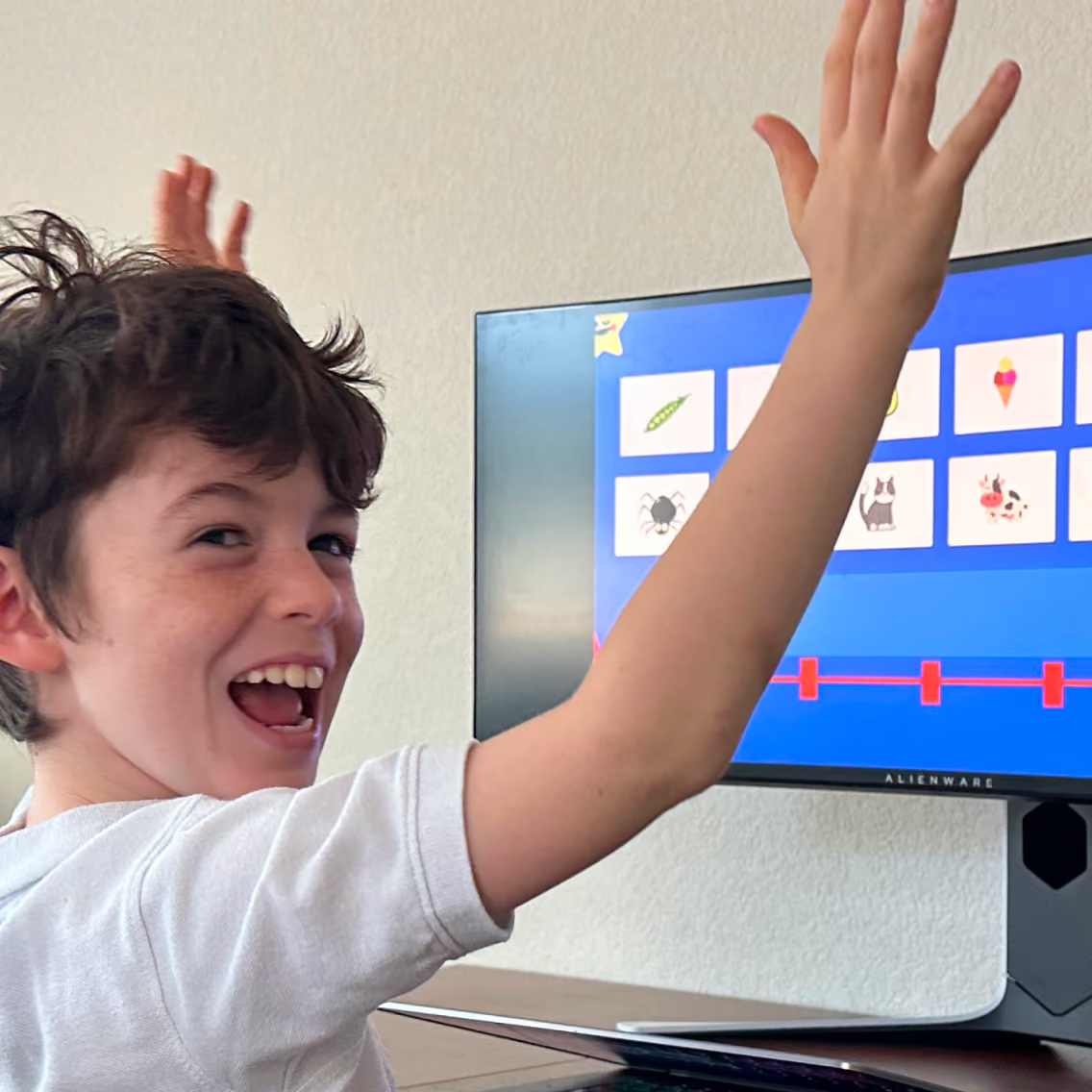
Welcome to CE2
- Past tense mastery (passé composé and imparfait)
- Advanced grammar (sentence types, complements, pronouns)
- Future tense conjugation (futur simple)
- Complex sentence structure with linking words
- Sophisticated vocabulary (synonyms, antonyms, word families)
- Multi-paragraph writing with proper structure
- Advanced spelling rules (participle vs infinitive, accents)
- 25 or 50-minute French classes for kids online
Trusted by 500+ families | Perfect 5/5 rating

What your child willlearn
Our students master advanced French grammar by using past tenses (passé composé and imparfait) alongside the future tense (futur simple). They learn to construct complex sentences, understand implicit meanings in reading, and write multi-paragraph narratives with proper punctuation and advanced spelling rules.

Objectives



Skills









What Parents Say AboutOur CE2 Program



Is right for your child?


Your child’s journey through Level 4 CE2
Sentence Types & Present Tense Review
• Verbal and non-verbal sentences (phrases verbales et averbales)
• Sentence types (declarative, interrogative, exclamatory, imperative)
• Interrogative sentences and question formation
• Exclamatory sentences (Quel beau jour!)
• Imperative sentences (commands and instructions)
• Punctuation review and expansion (quotation marks, semicolon, colon)
• Past, present, and future distinction
• Identifying verbs in sentences
• 3 verb groups review (-ER, -IR, -RE/OIR)
• Verb infinitives
• Present tense: être, avoir, and aller - complete review
• Personal pronouns review (je, tu, il, elle, nous, vous, ils, elles)
• Present tense: -ER verbs - all conjugations (aimer, jouer, manger, regarder, parler, écouter)
• General writing vs pronunciation review
• Writing sound [s]: S, SS, C, Ç, SC
• Accents, trema (tréma), and cedilla (cédille)
• Double consonants (mm, nn, ss, ll, rr, tt)
• Hard G vs soft G (gare vs girafe)
• Spellings: est/es/et, a/as/à, ou/où, ce/se/ces/ses
• Hobbies and interests (centres d'intérêt)
• Time adverbs (hier, aujourd'hui, demain, maintenant, bientôt)
• Seasons and seasonal activities
• Understanding word meaning from context
• 5 continents
• Animals and their habitats
• Comparatives (plus petit, moins grand, aussi grand)
• Food ingredients and meals
• Quantity adverbs (beaucoup, peu, trop, assez)
• Vacation destinations
Write about interests, describe seasonal activities, ask questions, write exclamations, write commands and instructions
Your child identifies all sentence types, masters present tense conjugation, and understands complex punctuation!
Passé Composé & Sentence Structure
• Punctuation mastery (all signs: period, comma, semicolon, colon, quotation marks, exclamation, question mark)
• Affirmative and negative sentences
• Minimal sentence (phrase minimale: subject + verb)
• Two sentence groups (subject group + verbal group)
• -IR verbs in present tense - all conjugations (finir, choisir, grandir, réussir)
• Futur proche review (aller + infinitive)
• Passé composé introduction: être, avoir, and aller
• Passé composé: -ER verbs (j'ai mangé, tu as joué, il a parlé)
• Passé composé: -IR verbs (j'ai fini, tu as choisi, il a grandi)
• Compound words (mots composés)
• Sound [ɛ]: AI, È, Ê (accents on E review)
• Sound [ɛ̃]: IN, EIN, AIN, EN, IM (pain, plein, demain, vent, simple)
• Participe passé (-é) vs infinitive (-ER): mangé or manger?
• Frequency adverbs (toujours, souvent, parfois, rarement, jamais)
• Label words (mot-étiquette: fruits, animals, vehicles)
• General adverbs
• Lexical field (champ lexical)
• Talking about your weekend in past tense
Write negative sentences, create minimal sentences, write weekend stories in passé composé, distinguish participle from infinitive
Your child masters passé composé for all 3 verb groups and understands subject-verbal group structure!
Imparfait & Noun Groups
• Linking two sentences with conjunctions (et, mais, ou, donc, car)
• Common nouns and proper nouns
• Gender and number (masculine/feminine, singular/plural)
• Noun phrase: determiner + noun
• Noun phrase with qualifying adjective
• Noun phrase with complement (le livre de Marie)
• Complete noun phrase synthesis (determiner + noun + adjective + complement)
• Subject-verb agreement mastery
• Imparfait introduction: être, avoir, and aller (j'étais, tu avais, il allait)
• Imparfait: -ER verbs (je mangeais, tu jouais, il parlait)
• Imparfait: -IR verbs (je finissais, tu choisissais, il grandissait)
• Imparfait: 3rd group verbs -RE, -OIR, -IR (je prenais, je voulais, je venais)
• Participe passé (-é) vs imparfait (-ait): mangé or mangeait?
• Choosing between ont/on, sont/son
• Plural of words ending in -al, -ail, -ou (cheval→chevaux, travail→travaux, genou→genoux)
• Letter M before m, b, p (emmener, tomber, compter)
• Words ending in -tion, -sion (attention, passion)
• Synonyms (mots synonymes)
• Homonyms (homonymes: ver/verre/vers/vert)
• Antonyms (mots antonymes)
• From adjective to noun (beau→beauté, grand→grandeur)
• From verb to noun (jouer→jeu, lire→lecture)
Link sentences with conjunctions, write with imparfait, create noun phrases, transform adjectives and verbs into nouns
Your child masters imparfait, distinguishes it from passé composé, and creates complex noun phrases!
Future Tense & Sentence Complements
• Gender and number agreement in noun phrases
• Pronouns as subject replacements (il, elle, ils, elles replacing nouns)
• Direct and indirect object complements (COD, COI)
• Pronouns le, la, les, l' as object replacements
• Circumstantial complements (movable and deletable): time, place, manner
• Future tense (futur simple): avoir, être, aller (j'aurai, tu seras, il ira)
• Future tense: -ER verbs (je mangerai, tu joueras, il parlera)
• Future tense: -IR verbs (je finirai, tu choisiras, il grandira)
• Finding final silent letters in words
• Choosing between leur/leurs
• Silent H vs aspirated H (l'homme vs le héros)
• Feminine nouns ending in [e], [te], [tje]: la fée, la santé, une moitié
• Comparison vocabulary
• Language registers (familiar, standard, formal)
• Talking about events
• Fair and celebration vocabulary (fête foraine)
Write with future tense, create sentences with direct and indirect objects, write event descriptions, use appropriate language register
Final comprehensive CE2 assessment - All tenses, grammar, writing
Your child has completed the CE2 French program and masters past tenses, future tense, and advanced grammar! Ready for CM1 (4th grade)!**

FAQsabout onlineFrench classes for kids
Not at all. All levels are welcome, including complete beginners who have never heard a word of French. Our native teachers use games, visuals, and storytelling to make everything clear and fun from the very first lesson, no prior knowledge needed, just a smile and a screen.

Your child gets a free 25-minute 1-on-1 lesson with a native French teacher. No credit card required, no automatic billing, and absolutely no commitment. You simply decide afterward whether you’d like to continue most families book their first week the same day.
Just a computer or tablet with a camera and a stable internet connection. We use Zoom, you’ll receive a link before every session. No special software, no materials to buy, and no complicated setup. If your child can join a video call, they’re ready to go.
Apps and group classes give every child the same experience. We don’t. Every lesson at Little French Speakers is 100% personalized, built around your child’s level, pace, interests, and goals. They work 1-on-1 with a real native teacher who adapts in real time. No algorithm, no waiting, no getting lost in a group. Just your child and a teacher who’s fully focused on them.
After the free trial, you will receive an email with your child’s level placement and the recommended class duration based on their attention span.
Yes, it is absolutely possible to organize classes for siblings or friends, as long as the children are of a similar age and have a comparable level of French.

Join our amazing French class!
- Personalized 1-on-1 lessons
- 25 minute or 50 minute classes
- All teachers are native French speakers
- 100% online interactive program